
SEO vs Google Ads: Which Is Better for a Local Business?
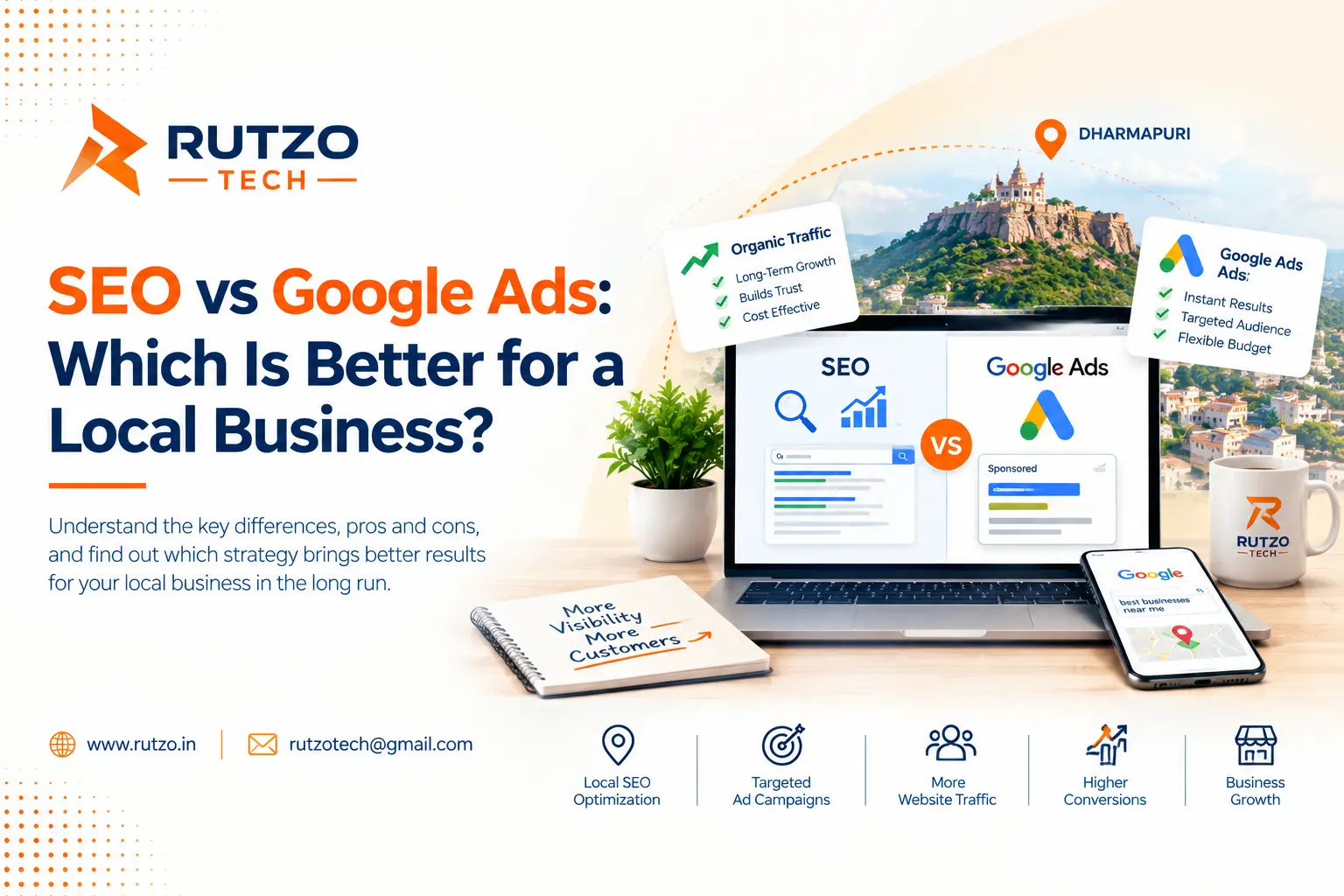
SEO vs Google Ads: Which Is Better for a Local Business?
If you run a business in Dharmapuri, Salem, or another local market, you have probably wondered whether you should invest in SEO or Google Ads to attract more customers.
You may want your business to appear when people search for your services. You may also want more phone calls, website enquiries, quotation requests, or visits to your shop.
But with a limited marketing budget, choosing where to invest can be difficult.
Should you invest in SEO to improve your organic visibility over time? Should you run Google Ads to reach potential customers sooner? Or should you use both?
The right answer depends on your business goals, competition, budget, website quality, and how quickly you need enquiries.
In this guide, we will compare SEO and Google Ads from a local business perspective, explain their costs and limitations, and help you decide which approach makes sense for your business.
What Is SEO?
SEO stands for Search Engine Optimization. It involves improving your website and online presence so search engines can understand your business and users can find useful, relevant information.
For example, a software development company in Dharmapuri might want its website to appear when someone searches for:
- Software company in Dharmapuri
- IT company in Dharmapuri
- Website development company in Dharmapuri
- Custom software development services
SEO can include improving service pages, publishing helpful articles, fixing technical website problems, strengthening internal links, and building legitimate authority.
For eligible local businesses, it can also work alongside Google Business Profile optimization to improve the quality and consistency of their local online presence.
The main idea: SEO helps your business earn visibility in organic search results rather than paying Google for each advertising click.
What Is Google Ads?
Google Ads is Google's paid advertising platform. Businesses can create campaigns to show advertisements to relevant audiences based on factors such as search terms, location, and campaign settings.
For example, a website development company could run a Search campaign targeting people looking for website development services in its service area.
When someone searches for a relevant service, an eligible advertisement may appear in a sponsored section of Google Search.
With a cost-per-click campaign, you generally pay when someone clicks your advertisement. You control your campaign budget, but the actual cost of clicks and the number of enquiries you receive can vary.
Google Ads can help you test an offer or reach potential customers without waiting for your organic rankings to improve. However, advertising does not guarantee customers, and paid advertisements do not directly improve your organic search rankings.
SEO vs Google Ads: The Main Differences
| Factor | SEO | Google Ads |
|---|---|---|
| Visibility | Earned organic search visibility | Paid advertising placements |
| Time to results | Usually takes time; progress varies | Can begin generating traffic after a campaign is eligible and running |
| Payment model | No charge to Google for an organic click, but work and tools may cost money | Search campaigns commonly charge per click |
| Budget control | You control how much to invest in SEO work | You can set and manage an advertising budget |
| Long-term value | Useful pages may continue attracting organic traffic if maintained | Traffic generally depends on continued campaign delivery and spend |
| Testing offers | Changes and results may take time to evaluate | Offers and ad messages can be tested more directly |
| Competition | Organic competition affects visibility | Ad auctions, bids, relevance, and other factors affect delivery and cost |
| Best use | Building organic visibility and useful website content | Reaching potential customers through paid campaigns |
Neither method is automatically better. Each solves a different part of the customer acquisition problem.
1. When Is SEO Better for a Local Business?
SEO is particularly worth considering when your business wants to build a lasting online presence and attract relevant visitors over time.
You want customers to discover your expertise
Potential customers often research a service before contacting a provider.
A useful website article can answer their questions, explain the available options, and introduce your business to people who may later need your services.
For example, an article explaining how to choose a software development company can attract readers who are comparing providers before requesting a quotation.
You want to build visibility for multiple services
A business may offer several services, each with different search intent.
A software company might create useful pages for website development, mobile applications, custom software, and SaaS products. Each page can explain the relevant service and address the customer's questions.
This creates opportunities to attract relevant organic traffic from different searches rather than relying on a single advertisement.
You want to reduce dependence on paid traffic
If your business receives all its website visitors through advertising, reducing or pausing your campaigns can significantly affect traffic from those ads.
SEO provides another potential source of visitors. However, organic visibility still requires maintenance, useful content, technical improvements, and adaptation to changing search results.
You can invest consistently
SEO is usually not the right choice if you expect guaranteed leads within a few days.
Google explains that some SEO changes can take months to show an impact, and results are not guaranteed. Businesses should evaluate progress over time rather than expecting instant rankings.
SEO may be a strong fit if:
- You want to build organic visibility over time.
- Your customers regularly research services online.
- You can invest in useful website content and technical quality.
- You want to build a stronger foundation beyond paid advertising.
- You can measure progress over a realistic period.
2. When Are Google Ads Better for a Local Business?
Google Ads may be a better starting point when you need to test demand, promote a specific service, or reach relevant searchers without waiting for organic rankings to develop.
You need to test a new service
Imagine you have launched a new website development service and want to understand whether people searching in your target area are interested in your offer.
A carefully targeted Search campaign can help test relevant keywords, advertisements, landing pages, and enquiry rates.
The results can inform future marketing decisions, although a small campaign may not provide enough data to draw firm conclusions.
You have a time-sensitive offer
A business promoting a seasonal service, event, limited-time offer, or new product may need visibility within a specific period.
Google Ads gives you the ability to manage campaign timing and budgets more directly than waiting for a new organic page to gain visibility.
You already have a page that converts visitors
Paid traffic is more useful when it leads to a relevant page that explains the offer and makes it easy to enquire.
If your website is slow, confusing, or missing essential information, fix those problems before significantly increasing advertising spend.
You can track the results
Google Ads can report on campaign interactions and, when conversion tracking is configured correctly, actions such as enquiry submissions and calls.
This allows you to assess whether the campaign is producing useful business opportunities rather than merely generating clicks.
Google Ads may be a strong fit if:
- You need to test demand for a service.
- You have a clear offer and target audience.
- You can fund a controlled advertising test.
- Your website or landing page is ready to receive visitors.
- You can measure qualified enquiries and sales.
3. Which Is Cheaper: SEO or Google Ads?
This is one of the most common questions, but there is no universal answer.
SEO does not mean marketing is free. Even though you do not pay Google for organic clicks, you may invest in research, content creation, technical development, website improvements, reporting, and professional services.
Google Ads involves direct advertising expenditure, and you may also pay for campaign management, landing page development, creative work, and conversion tracking.
Both approaches have costs. The important question is what those costs produce for your business.
Understanding the cost of SEO
SEO costs depend on your website's starting condition, competition, number of services, content requirements, technical issues, and the amount of ongoing work required.
A small business with a well-structured website may need a different level of investment from a business competing in a crowded market with a weak website and many service pages to improve.
When comparing SEO quotations, check whether they include:
- Technical website audits and fixes
- Keyword and search intent research
- Service page improvements
- Helpful article planning and writing
- Internal linking
- Google Business Profile support, where relevant
- Performance reporting
Understanding the cost of Google Ads
Google Ads costs vary according to the search market, competition, campaign setup, bids, targeting, and the relevance of your advertisements.
You can control your budget, but setting a budget does not guarantee a particular number of clicks, enquiries, or customers.
When planning a campaign, consider both the media budget and any separate management fees.
Compare cost per qualified lead, not just traffic
Suppose two marketing campaigns have different costs and produce different numbers of qualified enquiries. The cheaper campaign is not necessarily the better one if its leads rarely become customers.
Use this calculation:
Cost per qualified lead = Total marketing cost ÷ Number of qualified leads
For a fair comparison, include the relevant costs for each channel and use the same definition of a qualified lead.
For example, a lead who genuinely needs your service and can afford it is usually more valuable than an irrelevant enquiry that never progresses.
4. A Simple Example for a Dharmapuri Business
Consider a hypothetical website development company in Dharmapuri that wants to attract more local business customers.
The company has two possible approaches.
Option A: Focus on SEO
The company improves its website, creates a dedicated website development service page, publishes a practical article about choosing a developer, and strengthens its local business information.
The aim is to build organic visibility for relevant searches over time.
This approach may be suitable if the company can invest consistently and does not depend on immediate results from a new campaign.
Option B: Focus on Google Ads
The company launches a Search campaign targeting relevant website development searches in its service area. Visitors land on a page explaining the service, project process, and enquiry options.
The company measures clicks, qualified enquiries, and the number of enquiries that become customers.
This approach may be suitable if the company wants to test demand or reach potential customers sooner.
Option C: Combine SEO and Google Ads
The company runs a controlled advertising campaign while improving its organic website visibility.
Advertising helps test which searches and messages attract qualified enquiries. SEO work builds useful pages and content that can continue serving customers over time.
The company reviews both channels and invests more in the activities that contribute to profitable business outcomes.
These are illustrative approaches, not predictions of how many leads a business will receive. Actual results depend on competition, service demand, campaign quality, website experience, pricing, and sales follow-up.
5. What If Your Business Has a Small Marketing Budget?
If your budget is limited, do not automatically spend it all on advertising or all on SEO.
First, identify the main obstacle preventing your business from getting customers online.
- No proper website: Build a clear, mobile-friendly website or landing page with essential business information and working contact options.
- Incomplete Google Business Profile: Correct the information and make sure the profile accurately represents your business.
- Very little organic visibility: Start with the most important service pages, technical basics, and useful content.
- Need to test immediate demand: Consider a small, controlled Google Ads campaign if the service has relevant search demand and you can measure results.
- Visitors but few enquiries: Improve the page, offer, trust signals, and contact process before trying to attract substantially more traffic.
There is no need to launch every marketing activity simultaneously. Fix the most important weakness first, measure the result, and choose the next step based on evidence.
6. Why Google Ads Can Fail Even With a Good Budget
Paying for clicks does not mean paying for customers.
A campaign can underperform for several reasons:
- The keywords attract people who are not looking for your service.
- The targeting includes locations you cannot serve.
- The advertisement promises something the landing page does not deliver.
- The website is slow or difficult to use on mobile.
- The enquiry form is broken or too complicated.
- The business does not respond to enquiries promptly.
- Conversion tracking is missing or configured incorrectly.
- The service price or offer does not meet customer expectations.
For example, a company may receive many clicks from people looking for free website builders when its actual service is paid custom website development.
Search term reviews and suitable negative keywords can help reduce irrelevant traffic. Landing page improvements and reliable conversion tracking can also help you make better decisions.
Before increasing your budget, identify where potential customers are being lost.
7. Why SEO Can Fail Even After Publishing Many Articles
Publishing more content does not automatically produce better rankings.
A website can have dozens of articles and still struggle to attract useful traffic if the content is repetitive, inaccurate, too general, or unrelated to the services the business provides.
Common SEO problems include:
- Targeting keywords without understanding search intent.
- Publishing generic articles that offer little practical value.
- Creating multiple pages that compete for the same search.
- Ignoring technical indexing or mobile usability problems.
- Failing to link relevant articles to useful service pages.
- Expecting immediate rankings for highly competitive searches.
- Measuring rankings without checking enquiries or customer outcomes.
Instead of publishing content simply to increase article count, identify the questions your customers need answered and produce genuinely useful pages that address those questions.
A smaller collection of strong, relevant pages can be a better foundation than a large collection of repetitive content.
8. Should You Use SEO or Google Ads for Google Maps?
Local businesses often confuse Google Maps visibility, organic website rankings, and paid advertising.
These are related parts of online marketing, but they are not the same thing.
Google Business Profile and local visibility
For eligible businesses, a complete and accurate Google Business Profile can help customers discover the business through Google Search and Maps.
Keep the business information accurate, select relevant categories, add genuine photos, and encourage honest reviews. Local results depend on factors including relevance, distance, and prominence, so these actions do not guarantee a particular position.
Organic website SEO
Your website can attract visitors through organic search results when its pages are relevant and useful for the searches people make.
Google Ads
Paid campaigns can create advertising opportunities for eligible searches and local actions, depending on campaign type and settings.
Paying for Google Ads does not buy a better organic ranking. Decide which channel you need based on the type of visibility and business result you want.
9. How to Decide Which Strategy Is Right for Your Business
Use the following decision guide as a starting point.
| Your Situation | Suggested Starting Point |
|---|---|
| You need to test a new service quickly. | Consider a controlled Google Ads test with a suitable landing page. |
| You want to build organic visibility over time. | Invest in SEO fundamentals and useful service content. |
| You depend on local customers finding your business. | Improve your Google Business Profile, local website information, and relevant SEO. |
| You get website visitors but very few enquiries. | Investigate the website, offer, contact process, and lead quality before increasing traffic. |
| You already receive profitable enquiries from Ads. | Consider scaling carefully while maintaining campaign quality and measuring results. |
| You want both immediate testing and longer-term visibility. | Consider combining paid campaigns with a consistent SEO plan. |
This is a decision framework, not a universal rule. Your budget, margins, customer buying cycle, and ability to fulfil new demand should influence the final choice.
10. A Practical 90-Day Marketing Plan
If you are unsure where to begin, the following plan provides a structured way to improve your online customer acquisition.
Days 1–30: Fix the foundation
- Review your website's mobile experience and performance.
- Check your Google Business Profile information.
- Improve your most important service page.
- Make contact options and enquiry forms easy to use.
- Set up appropriate analytics and conversion tracking.
Days 31–60: Build visibility and test demand
- Research relevant search terms and customer questions.
- Publish a useful article related to your core service.
- Improve internal links between relevant articles and service pages.
- If appropriate, run a controlled Google Ads campaign with a defined objective and budget.
- Review search terms and the quality of incoming enquiries.
Days 61–90: Evaluate and improve
- Review organic performance in Google Search Console.
- Review available Google Business Profile performance data.
- Compare campaign costs with qualified leads and sales.
- Improve pages and campaigns that are underperforming.
- Prioritise the activities showing the strongest evidence of business value.
Do not treat 90 days as a guaranteed deadline for SEO success. The plan is intended to create a measurement and improvement process, while actual results depend on your starting point and market.
Final Verdict: SEO vs Google Ads
So, which is better for a local business?
SEO is worth prioritising when your goal is to build organic search visibility and useful online assets over time.
Google Ads is worth considering when you need paid visibility, want to test demand, or have a specific offer to promote.
Using both can make sense when your business has the budget, website quality, and measurement systems to support them.
There is no universally correct choice. The right strategy is the one that fits your business goals and produces worthwhile results at a cost your business can sustain.
Do not choose a channel because someone promises instant rankings or guaranteed customers. Understand the costs, measure qualified enquiries, and keep improving the customer experience.
Need Help With SEO or Google Ads?
Rutzo Tech combines technology and digital marketing services, including website development, custom software, mobile applications, SaaS products, SEO, social media management, Meta Ads, and Google Ads.
If your business wants to improve its online visibility, start by identifying whether the biggest gap is discoverability, website conversion, or lead quality. That will help you choose a more sensible marketing investment.
Visit Rutzo Tech to explore our services and discuss your business requirements.
Looking to implement this technology in your business?
Rutzo Tech engineers custom software, scalable web platforms, and mobile apps tailored specifically to your workflows.
Discuss Your Project with Our TeamRelated Articles
 Marketing
Decoding Digital Marketing: How Modern Brands Scale and Dominate Online
Digital marketing isn't just about posting on social media—it's a high-impact growth engine. Disco...
Read Article Marketing
Mastering Search Engine Optimization: How to Build 24/7 Organic Growth for Your Business
Stop relying solely on expensive paid ads. Discover how a robust SEO strategy drives consistent, hig...
Read Article Marketing
How to Improve Your Google Business Profile Ranking in Dharmapuri
Improve your Google Business Profile ranking in Dharmapuri with practical local SEO steps covering c...
Read Article