
Custom Software vs Ready-Made Software: Which Is Right for Your Business?
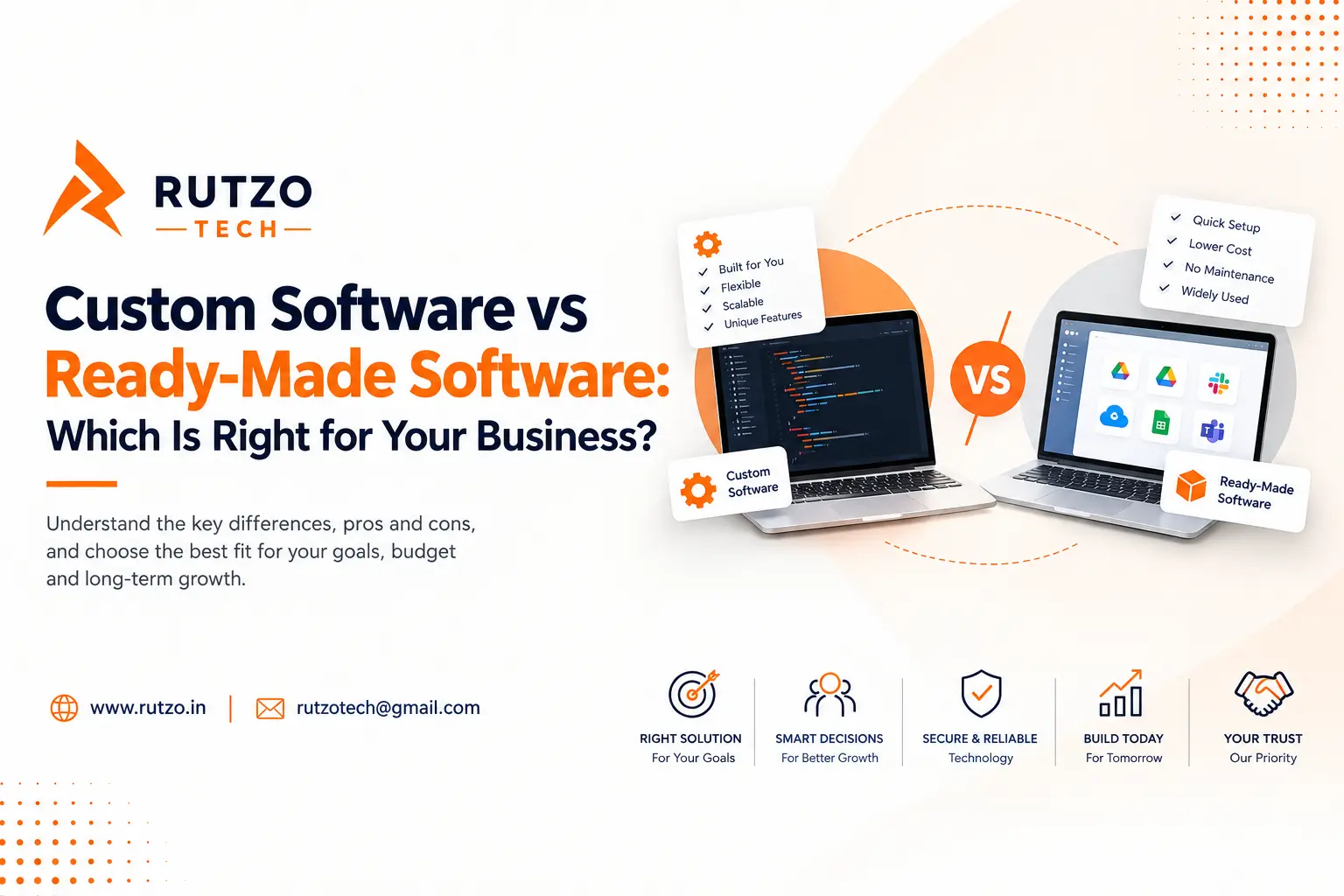
When a business needs new software, one of the first questions is usually: Should we build custom software or use an existing software product?
There is no universal answer.
Ready-made software can be faster and simpler to start with. Custom software can be a better fit when a business has unique workflows, complex requirements, or needs greater control over how its systems work.
The mistake is choosing one simply because it is cheaper, newer, or more popular.
The better question is:
Which option solves our actual business problem with the right balance of cost, time, flexibility, control, and long-term value?
This guide explains the difference between custom software and ready-made software and gives you a practical framework for deciding which approach makes sense for your business.
What Is Ready-Made Software?
Ready-made software is an existing product developed for a broad group of businesses or users.
Instead of building the software specifically for your company, you subscribe to or purchase an existing solution and configure it for your requirements.
Examples can include software for:
- Accounting
- Customer relationship management
- Project management
- Human resources
- Inventory management
- Communication
- Marketing
- Document management
The main idea is simple: the software already exists before your business starts using it.
What Is Custom Software?
Custom software is developed specifically around the requirements of a particular business, organization, or product.
Instead of changing your business process to fit an existing application, the software can be designed around the workflow you actually need.
For example, a company might need a system that combines:
- Customer management
- Project management
- Employee operations
- Inventory
- Reports
- Payments
- Internal approvals
- Third-party integrations
If existing products cannot handle the required workflow without major compromises, custom software may be considered.
Custom Software vs Ready-Made Software at a Glance
| Factor | Ready-Made Software | Custom Software |
|---|---|---|
| Initial setup | Usually faster | Requires development time |
| Initial cost | Often lower | Usually higher |
| Customization | Limited to available options | Built around your requirements |
| Business workflow | Business may need to adapt | Can be designed around the workflow |
| Integrations | Depends on available integrations | Can be developed for required systems |
| Control | Depends on the provider | Greater control over the solution |
| Scalability | Depends on the product | Can be planned around future requirements |
| Maintenance | Usually handled by the vendor | Requires an ongoing maintenance approach |
| Time to start | Often short | Longer because the product must be developed |
These are general differences, not guarantees. The actual cost, timeline, flexibility, and maintenance requirements depend on the specific software product and project.
Why Businesses Choose Ready-Made Software
Ready-made software can make sense when the business requirement is relatively common and the available product already solves the problem well.
1. You Can Start Faster
You are not starting the project from zero.
The software has already been developed, tested, and deployed by its provider. Depending on the product, your business may be able to create an account, configure settings, import data, and start using it relatively quickly.
This can be useful when the business needs a solution immediately.
2. Lower Initial Development Effort
Because the software has already been built, you are generally not paying for an entire product to be developed specifically for your company.
Instead, you may pay through a subscription, licence, implementation fee, or another pricing model.
However, don't compare only the monthly or annual subscription price. Consider the total cost of using the software over the period your business expects to rely on it.
3. Vendor Handles Product Development
With many ready-made products, the vendor is responsible for maintaining the core application and releasing updates.
That can reduce the amount of technical work your own business needs to manage.
4. The Software May Already Be Proven
If a product is widely used and matches your requirements, you may benefit from an existing ecosystem, documentation, integrations, and established workflows.
But popularity should not be confused with suitability.
A popular product can still be the wrong product for a particular business.
Where Ready-Made Software Can Become a Problem
Ready-made software becomes less attractive when your business process does not fit the product well.
Your team has to constantly work around the software
Imagine a business process that requires five steps, but the software supports only three.
Your team may start creating spreadsheets, manually transferring information, using WhatsApp for missing communication, or maintaining separate records.
At that point, the software may technically be solving a problem while creating another one.
You need features the product does not support
Some products provide configuration options and integrations. Others may have strict limitations.
If a feature is fundamental to your business and the vendor cannot provide it, you have to decide whether the business process can change or whether another solution is necessary.
Your data and workflow depend on the vendor
Before selecting a ready-made product, understand how data export, account access, integrations, pricing changes, and cancellation work.
These details become increasingly important when the software becomes critical to your daily operations.
Why Businesses Choose Custom Software
Custom software becomes more relevant when the business has requirements that cannot be handled effectively by existing products.
1. The Software Can Match Your Actual Workflow
Suppose your company has a specific approval process that is different from the standard workflow supported by common software.
With custom development, the system can be designed around the process rather than forcing employees to change everything to match an existing application.
This does not mean every existing process should be converted into software exactly as it currently works.
A good development project should also question unnecessary steps and improve the workflow where appropriate.
2. You Can Build Only What You Need
Ready-made software may contain dozens of features your team never uses.
Custom software can focus on the functionality that matters to your business.
That can be particularly useful when the software is intended to become an important internal system or a commercial product.
3. Integrations Can Be Designed Around Your Systems
Businesses often use multiple systems.
For example, a company might need its software to communicate with payment services, accounting systems, customer databases, communication platforms, or internal applications.
With custom development, integrations can be planned as part of the architecture rather than relying only on the integrations offered by an existing software vendor.
4. The Product Can Evolve With the Business
Businesses change.
Your current workflow may not be the same one you need two or three years from now.
A custom system can be developed with future requirements in mind, although scalability is not automatic. The architecture, code quality, infrastructure, and development decisions still determine how easily the software can evolve.
Where Custom Software Can Become a Problem
Custom software is not automatically the better option simply because it is more flexible.
It takes time to build
A custom application has to go through requirements, planning, design, development, testing, deployment, and ongoing improvement.
If your business needs a basic solution immediately and a good ready-made product already exists, building from scratch may not make sense.
It requires a larger initial investment
Custom development requires people to analyse, design, build, test, and deploy the software.
The initial investment can therefore be significantly higher than subscribing to an existing product.
But the opposite can also be true over the long term in some situations. Subscription costs, per-user charges, implementation costs, workarounds, and multiple disconnected tools can add up.
That is why the correct comparison is not simply:
Custom = expensive
and
Ready-made = cheap.
The actual business case depends on the total cost and value over time.
It requires ongoing responsibility
Custom software needs maintenance.
That can include security updates, bug fixes, infrastructure changes, performance improvements, backups, monitoring, and new features.
If you build custom software, you should have a realistic plan for who will maintain it.
What About the Total Cost?
This is where many software decisions become misleading.
Looking only at the initial development cost does not give you the complete picture.
For a ready-made product, consider:
- Subscription or licence fees
- Number of users
- Implementation costs
- Premium features
- Integration costs
- Data migration
- Training
- Additional products required to fill gaps
- Vendor price changes
For custom software, consider:
- Requirements and planning
- UI/UX design
- Development
- Testing
- Hosting and infrastructure
- Maintenance
- Security updates
- Future development
- Technical support
The useful question is:
What will this solution cost my business over the period I expect to use it?
That gives you a much better basis for comparison than looking only at the first payment.
When Ready-Made Software Is Usually Worth Considering
A ready-made solution may be worth considering when:
- Your business requirement is common.
- An existing product already covers most of your workflow.
- You need the software quickly.
- You want to minimise initial development work.
- The available integrations meet your requirements.
- Your business can reasonably adapt its workflow to the product.
For example, if you need a standard accounting function and an established product already provides the features your business needs, building an accounting system from scratch would usually require a strong reason.
When Custom Software Is Worth Considering
Custom development may be worth investigating when:
- Your business has unique workflows.
- Existing software requires too many compromises.
- You need several systems to work together.
- Your software itself is part of your competitive advantage.
- You are building a SaaS product for customers.
- You require specialised business rules.
- You need greater control over the product and its future direction.
For example, a company that has developed a specialised operational process may find that repeatedly adapting generic software creates more complexity than building a system around its actual workflow.
Don't Ignore the Third Option: Improve the Process First
There is another option that businesses often overlook.
You may not need new software yet.
Before spending money on development, map the current process.
Ask:
- Where exactly is the delay?
- Where are employees entering the same information twice?
- Which tasks are being performed manually?
- Which errors happen repeatedly?
- Which information is difficult to find?
- Which steps actually require software?
You may discover that the real problem is not a missing application but a poorly defined process.
Building software around a broken process simply turns the broken process into a digital system.
Custom Software Does Not Mean "Build Everything From Scratch"
Custom development does not necessarily mean reinventing every component.
A custom application can use established technologies, libraries, APIs, cloud services, authentication systems, payment providers, and other existing components.
The custom part is the way those components are combined and developed around the specific business requirement.
This distinction matters because good software development is not about rebuilding everything unnecessarily. It is about building the parts that actually need to be unique while using reliable existing technology where appropriate.
A Practical Decision Framework
If you are unsure which direction to take, answer these questions honestly.
Question 1: Does an existing product solve most of the problem?
If yes, start by evaluating ready-made options.
If no, investigate whether the missing requirements are critical or merely nice-to-have features.
Question 2: Can your business reasonably adapt to the existing software?
If changing your process would create little disruption, ready-made software may be sufficient.
If the required changes would damage an important business workflow, custom development becomes more relevant.
Question 3: Is the software itself strategically important?
If software is simply a supporting tool, buying an existing product may make sense.
If the software is central to how your company operates or is itself the product you sell, greater control may justify custom development.
Question 4: How quickly do you need the solution?
If you need a solution immediately, an existing product may have an advantage.
If you can invest time in building the right system, custom development may be practical.
Question 5: What happens if the business grows?
Consider future users, locations, workflows, integrations, data volume, and reporting requirements.
The right solution today should not create an avoidable problem tomorrow.
A Simple Example
Consider a growing construction company.
The company might start with spreadsheets, WhatsApp messages, and separate tools for project information.
Initially, a ready-made project-management application may solve most of the problem.
But as the company grows, it may need a workflow connecting project management, employee attendance, documents, financial information, field operations, and reporting.
If the existing tools can integrate effectively and still meet the requirements, continuing with ready-made software may be sensible.
If employees are constantly moving information between disconnected systems and the business has a workflow that existing products cannot handle properly, custom software may deserve consideration.
The point is not that custom software is better for construction companies.
The point is that the complexity and uniqueness of the business workflow should influence the technology decision.
Questions to Ask a Software Development Company
If you are considering custom software, do not simply ask for a quotation.
Ask the development company:
- Do I actually need custom software for this requirement?
- Could an existing product solve most of this problem?
- What would you build and why?
- What would you not build?
- What are the biggest technical risks?
- What is included in the development scope?
- How will the software be tested?
- Who will maintain it after launch?
- Who owns the source code and data?
- How can the system evolve in the future?
A good technology partner should be willing to tell you when custom development is not necessary.
That is an important distinction.
So, Which One Should You Choose?
There is no universal winner between custom software and ready-made software.
Choose based on the actual requirements of your business.
Ready-made software may make more sense when:
- The problem is common.
- An existing product already fits your workflow.
- You need to start quickly.
- You want to minimise initial development effort.
Custom software may make more sense when:
- Your workflow is genuinely unique.
- Existing products create significant compromises.
- You require specialised integrations.
- Software is an important part of your competitive advantage.
- You are building your own software product or SaaS business.
The important thing is not to choose custom software simply because it sounds more advanced, or ready-made software simply because it sounds cheaper.
Choose the solution that solves the business problem with the least unnecessary complexity while still supporting the direction your business is heading.
Final Thoughts
Custom software and ready-made software are not competing technologies. They are two different approaches to solving business problems.
Ready-made software gives businesses access to an existing solution without having to build everything themselves.
Custom software gives businesses greater control over workflows, features, integrations, and product direction, but it also requires a larger development commitment and an ongoing maintenance plan.
Before making the decision, understand your current process, identify the actual problem, investigate existing solutions, calculate the longer-term cost, and consider where the business is heading.
Most importantly, do not start a custom software project simply because someone tells you that "custom is better."
And don't choose ready-made software simply because the monthly subscription looks inexpensive.
The right software is the one that solves the right problem for the right business at the right stage of growth.
Need Help Evaluating a Software Requirement?
Rutzo Tech develops websites, mobile applications, custom software, and SaaS products for businesses that need solutions built around their requirements.
If you are unsure whether your business needs custom software or whether an existing solution could solve the problem, start by explaining the workflow and the problem you are trying to solve.
Talk to Rutzo Tech about your software requirement to discuss the problem before deciding on the technology.
Looking to implement this technology in your business?
Rutzo Tech engineers custom software, scalable web platforms, and mobile apps tailored specifically to your workflows.
Discuss Your Project with Our TeamRelated Articles
 Technology
How Much Does Custom Software Development Cost in Dharmapuri?
How much does custom software development cost in Dharmapuri? Learn what actually determines softwar...
Read Article Marketing
SEO vs Google Ads: Which Is Better for a Local Business?
SEO vs Google Ads—which is better for a local business? Compare costs, time to results, lead gener...
Read Article Marketing
How to Improve Your Google Business Profile Ranking in Dharmapuri
Improve your Google Business Profile ranking in Dharmapuri with practical local SEO steps covering c...
Read Article