
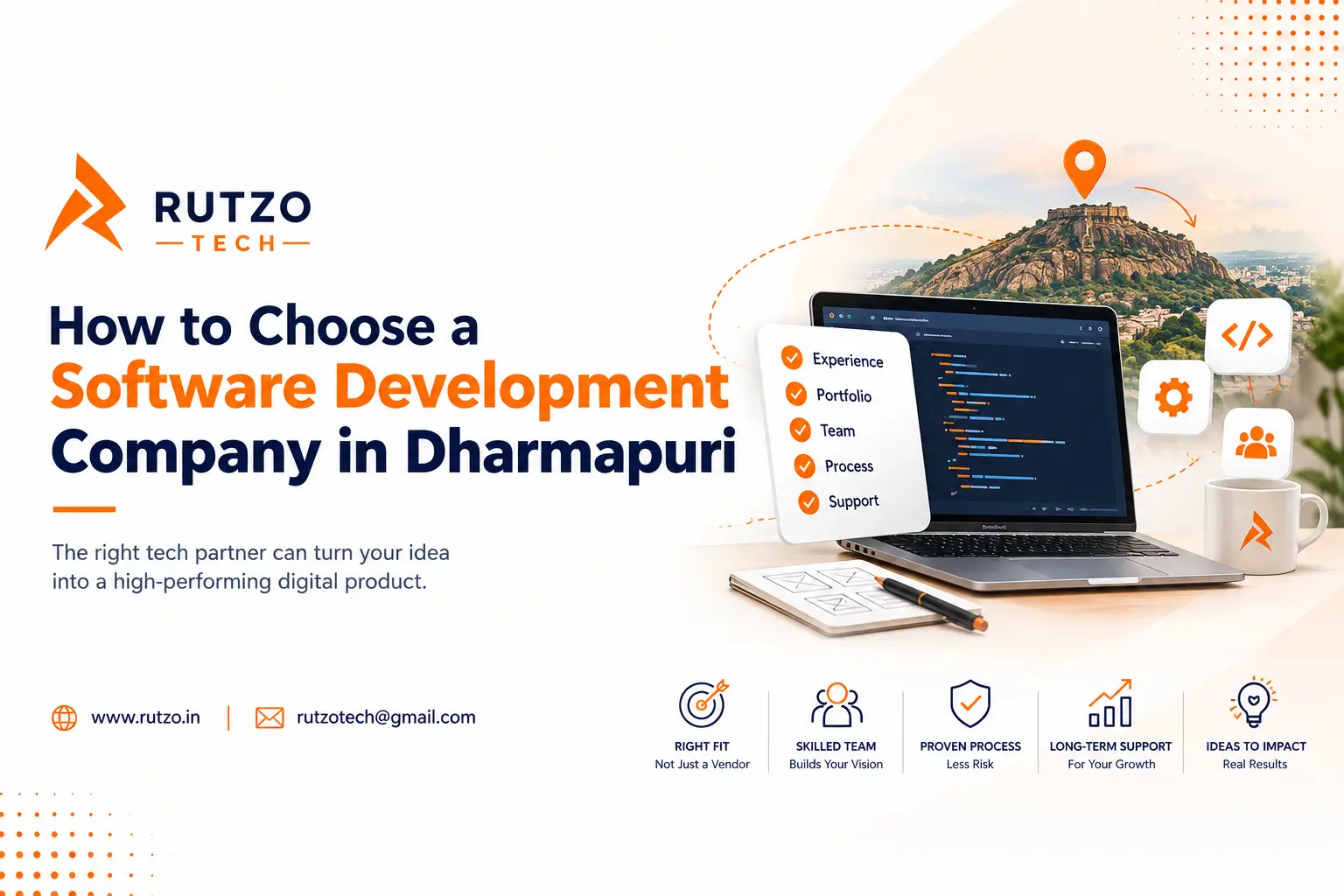
How to Choose a Software Development Company in Dharmapuri
Choosing a software development company is a business decision, not simply a technology decision.
If your business needs a website, mobile application, custom software, or SaaS product, the company you choose can affect much more than the initial development cost. It can affect how well the software fits your business, how easily it can be maintained, how secure it is, and how much time your team spends fixing problems later.
For a business in Dharmapuri, the search may start with a simple Google query such as "software development company in Dharmapuri" or "IT company in Dharmapuri." But finding companies is the easy part. The difficult part is determining which company is actually capable of solving your problem.
This guide gives you a practical way to evaluate a software development company before you sign a contract or pay a large advance.
Start With the Problem, Not the Software Company
One of the most common mistakes businesses make is contacting developers before clearly defining what they actually need.
For example, a business owner might say:
"I need an app for my business."
That is not yet a software requirement. It is only an idea.
A better starting point is to describe the problem.
For example:
- Our sales team currently manages customer enquiries through WhatsApp and spreadsheets.
- Our employees cannot easily track project status from the field.
- Customers need a way to book our services online.
- We need one system to manage customers, invoices, inventory, and reports.
- We want to turn an existing business process into a SaaS product.
Once the problem is clear, a good development company can help determine whether you actually need a mobile application, web application, custom software, SaaS platform, or perhaps a much simpler solution.
Do not start by asking, "What technology will you use?" Start by asking, "What business problem are we trying to solve?"
1. Make Sure the Company Understands Your Business
A developer can understand programming without understanding your business.
Those are two different skills.
During your first discussion, pay attention to the questions the company asks you.
Are they asking about your customers? Your employees? Your current workflow? Your existing systems? The problems you are facing? What happens when something goes wrong?
Or do they immediately start talking about technologies, screens, features, and prices?
The first conversation can tell you a lot.
A company that takes time to understand the business problem is in a better position to recommend a suitable solution than a company that starts with a predefined technology package.
A simple test
After explaining your business problem, ask the company:
"Can you explain back to me what you think our actual problem is?"
If they can clearly explain your requirement in simple language, that is useful evidence that they were listening.
2. Don't Be Impressed by a Long Technology List
Many software companies list dozens of programming languages, frameworks, databases, and platforms on their websites.
That information can be useful, but it should not be the main reason you choose a company.
Knowing React, Laravel, PHP, Node.js, Python, Flutter, or another technology does not automatically mean a company can build the right product for your business.
The more important question is whether the company can make sensible technical decisions for your particular requirements.
For example, two businesses may both want a mobile application, but their technical requirements could be completely different.
One may need a simple customer-facing application. Another may need a complex application connected to an existing database, payment system, internal dashboard, and third-party APIs.
Technology should serve the business requirement. The business requirement should not be forced into a technology simply because the developer prefers it.
3. Look at Real, Usable Work — Not Just Portfolio Images
A portfolio is useful, but you need to inspect it properly.
A screenshot can show you what an interface looked like. It cannot tell you how the actual software behaves.
When a company shows you a previous website or application, ask whether you can access the live version.
Then actually use it.
Check things such as:
- Does it work properly on a mobile phone?
- Is the navigation easy to understand?
- Do forms work correctly?
- Does the website load reasonably quickly?
- Does the application behave consistently?
- Does the interface make sense to someone who has never used it?
If the company cannot show any meaningful examples of completed work, ask why.
You should also ask what part of the project they actually handled. A company may display a project in its portfolio without having built the entire system itself.
4. Ask Who Will Actually Build Your Project
This is a question many business owners forget to ask.
The person explaining the project during the sales discussion may not be the person who designs the architecture or writes the code.
Ask:
- Who will be responsible for the technical side of my project?
- Who will communicate with me during development?
- Who reviews the code?
- Who handles testing?
- Will the same team remain involved throughout the project?
You do not need to become a software engineer to ask these questions.
You simply need to know who is responsible for turning the proposal into working software.
5. Ask the Company to Explain What "Finished" Means
This is one of the most useful questions you can ask before accepting a quotation.
Ask:
"When you say the project is completed, exactly what will I receive?"
A complete software project may involve much more than writing code.
Depending on the project, completion may include:
- UI/UX implementation
- Frontend development
- Backend development
- Database setup
- API integration
- Authentication and access control
- Testing
- Deployment
- Domain and hosting configuration
- Documentation
- Admin access
- Source-code access
- Initial post-launch support
Not every project requires every item on this list. The important thing is that both sides agree on what is included.
Many project disagreements are not really technology problems. They are scope problems.
6. Compare Quotations by Scope, Not Just by Price
Suppose three companies give you these quotations:
- Company A: ₹2 lakh
- Company B: ₹3.5 lakh
- Company C: ₹5 lakh
It would be a mistake to immediately conclude that Company A offers the best deal.
You do not yet know whether all three companies are quoting for the same thing.
One quotation might include design, testing, deployment, documentation, and support. Another might include only development.
Instead, create a simple comparison table:
| Item | Company A | Company B | Company C |
|---|---|---|---|
| UI/UX | Included? | Included? | Included? |
| Development | Included? | Included? | Included? |
| Testing | Included? | Included? | Included? |
| Deployment | Included? | Included? | Included? |
| Source code | Included? | Included? | Included? |
| Post-launch support | Included? | Included? | Included? |
The exact price matters, but the scope behind the price matters first.
7. Don't Accept a Vague Project Timeline
"We can finish it quickly" is not a useful project plan.
Ask the development company how the project will be divided into milestones.
For example:
- Requirement confirmation
- UI/UX approval
- Core development
- Feature testing
- Client review
- Bug fixing
- Production deployment
The exact number and duration of milestones will depend on the project.
The important part is having a process that allows you to see progress before the final day.
If you only see the software for the first time when the company says "the project is finished," problems may be discovered too late.
8. Ask How They Handle Changes
Business requirements often change during software development.
You may start with ten features and later realise that one feature needs to work differently. That is normal.
The problem occurs when nobody has agreed on how changes will be handled.
Ask:
- What happens when I request a new feature?
- How do you distinguish a bug from a new requirement?
- Will additional work require a separate quotation?
- How will changes affect the timeline?
A clear change process protects both the business owner and the development company.
9. Understand Source-Code and Account Ownership
Before paying for custom software, understand what you will own and what access you will receive.
This may include:
- Source code
- Database
- Domain
- Hosting
- Cloud accounts
- Repository access
- Business data
- Third-party service accounts
The exact ownership terms should be written into your agreement rather than discussed casually over WhatsApp.
If you are paying for custom software built specifically for your business, you should have a clear understanding of your rights and access after the project is completed.
10. Ask How Testing Is Done
One of the easiest ways to identify a weak development process is to ask a simple question:
"How do you test the software before giving it to me?"
A serious answer should explain more than "we test everything."
Depending on the project, testing can include checking:
- Forms
- User permissions
- Different user roles
- Mobile layouts
- Different browsers
- Error handling
- Database operations
- API integrations
- Performance
- Security-related behaviour
You do not need every type of testing for every project. What matters is that the company has a deliberate process for finding problems before your customers do.
11. Ask What Happens After Launch
A software project does not necessarily become problem-free the day it goes live.
Real users may discover issues that were not visible during development. Your business may also request improvements after seeing how people actually use the system.
Before signing, clarify:
- How long is initial support provided?
- What counts as a bug?
- How are new features handled?
- How are urgent problems reported?
- Is ongoing maintenance available?
Do not assume that "support" means unlimited future development.
Ask what the word actually means in the contract.
12. Watch for These Red Flags
You do not need to assume that every software company with one of these characteristics is bad. But these situations deserve additional questions.
Instant quotation without understanding the requirement
If you explain a complex business problem in five minutes and receive a fixed quotation immediately, ask how the company calculated the scope.
Only screenshots in the portfolio
Ask whether you can see live or verifiable examples where appropriate.
Unclear ownership terms
If nobody can clearly explain what happens to the code, data, hosting, and accounts after delivery, resolve that before development begins.
Everything is promised but nothing is documented
Important promises should appear in the proposal, scope, or agreement. Do not rely on verbal promises for important project requirements.
The cheapest quotation is dramatically cheaper than everything else
A low price is not automatically a problem. But a large price difference should make you ask what is different in the scope, team, process, or support.
13. What Should a Dharmapuri Business Consider Specifically?
A local business does not necessarily need a "local-only" software solution. What matters is whether the development company understands the business environment and can communicate effectively with the people using the software.
For example, a Dharmapuri business may be serving customers locally while also selling products or services across Tamil Nadu or India.
A software requirement could therefore involve:
- Local customer enquiries
- WhatsApp communication
- Online lead generation
- Payments
- Customer management
- Inventory
- Employee operations
- Project management
- Online bookings
- Business reporting
The important question is not simply whether the developer is physically located in Dharmapuri.
The better question is:
Can this company understand how my business works and build software around that workflow?
14. A Practical 30-Minute Evaluation You Can Do Before Hiring
You do not need to be a technical expert to perform a useful first evaluation.
Take three companies and give each of them the same short project description.
Then compare their responses.
Step 1: Explain the business problem
Describe what is currently happening and what you want to improve.
Step 2: Ask them to explain the proposed solution
Don't worry if you don't understand every technical term. Ask them to explain the solution in business language.
Step 3: Ask what they think could go wrong
This is an underrated question.
A company that identifies risks before development begins may be giving you more useful information than a company that promises that everything will be easy.
Step 4: Ask what is included
Get the scope in writing.
Step 5: Ask what happens after launch
Understand support, maintenance, ownership, and future changes.
Step 6: Compare the answers
Now compare the companies based on their understanding, proposed approach, scope clarity, communication, relevant experience, and support — not simply the lowest quotation.
15. Questions to Ask Before You Sign
Save this checklist and use it during your next software-company meeting:
- What problem do you think this software should solve?
- Have you built something similar before?
- Can I see relevant live work?
- Who will actually work on my project?
- Who will be responsible for technical decisions?
- What exactly is included in the quotation?
- What is not included?
- How will the project be divided into milestones?
- How will changes to the scope be handled?
- How will the software be tested?
- Who owns the source code?
- Who controls the domain and hosting?
- What happens to my data?
- What support is included after launch?
- How are future features charged?
Final Checklist: Before Choosing Your Development Partner
Before making a decision, you should be able to answer "yes" to most of these questions:
- I understand exactly what I am trying to build.
- The company understands my business problem.
- I have seen relevant examples of its work.
- I know who will actually work on my project.
- The proposed scope is written clearly.
- I understand what is included and excluded.
- The development milestones are understandable.
- I know how changes will be handled.
- I understand source-code and account ownership.
- I understand the testing approach.
- I know what support is available after launch.
- The company has explained risks instead of only promising results.
Conclusion
Choosing a software development company in Dharmapuri should not be reduced to a Google search, a portfolio screenshot, or the cheapest quotation you receive.
The better approach is to investigate how the company thinks, how it communicates, what it has actually built, how it defines scope, who will work on your project, how it tests software, and what happens after launch.
Most importantly, choose based on evidence rather than promises.
You do not need to become a software engineer to evaluate a development company. You need to ask clear questions and make sure the answers are specific enough to verify.
If a company can explain your business problem clearly, show relevant work, provide a transparent scope, explain its development and testing process, and clearly document ownership and support, you have much more useful information than a simple "we build websites and apps" sales pitch.
Need a Software Solution for Your Business?
Rutzo Tech works with businesses that need technology solutions such as websites, mobile applications, custom software, and SaaS products.
If you are planning a new software project, improving an existing system, or trying to replace a manual business process with software, the first step is to clearly understand the problem and requirements.
Talk to Rutzo Tech about your project and explain what you are trying to build. The discussion can start with the business problem before getting into the technology.
Looking to implement this technology in your business?
Rutzo Tech engineers custom software, scalable web platforms, and mobile apps tailored specifically to your workflows.
Discuss Your Project with Our TeamRelated Articles
 Business
Who is Rutzo Tech? The Future of Next-Gen Web Development & Digital Growth
Discover the story behind Rutzo Tech. We blend full-stack web development, premium UI/UX design, and...
Read Article Marketing
SEO vs Google Ads: Which Is Better for a Local Business?
SEO vs Google Ads—which is better for a local business? Compare costs, time to results, lead gener...
Read Article Marketing
How to Improve Your Google Business Profile Ranking in Dharmapuri
Improve your Google Business Profile ranking in Dharmapuri with practical local SEO steps covering c...
Read Article